 UK
UK
 Hawaii
 USA
USA
Ashes Into Jewellery, Glass or Fireworks? Your Options for Cremated Ashes Compared
Ashes Into Jewellery, Glass or Fireworks? Your Options for Cremated Ashes Compared
Meta title: What to Do With Ashes: Your Options Compared
Meta description: Compare ashes into jewellery, glass, fireworks, trees, diamonds, tattoos and professional scattering, including costs, care and practical considerations.
After a cremation, deciding what to do with ashes can feel like an important responsibility. Some families want to keep a small amount close. Others prefer a living memorial, a creative tribute or a ceremony that allows the ashes to be released.
There is no single correct choice. The right option depends on your relationship with the person, your family’s wishes, your budget and the kind of remembrance that feels peaceful.
This guide compares common cremation ashes keepsake ideas honestly, including the option of scattering ashes instead of keeping ashes.
The Ashes on the Shelf
An urn can provide comfort, especially soon after a death. It allows time to make a decision without pressure. For some people, simply knowing the ashes are at home feels reassuring.
For others, the urn gradually becomes part of an unfinished decision. It remains on a shelf, moved from room to room, while family members wonder whether they should keep it, divide it or arrange a final ceremony.
Take time. You do not have to choose the most permanent option immediately.

1. Keeping ashes at home or in an urn
Keeping ashes in an urn is familiar, private and often the least expensive choice. You can select a traditional urn, a biodegradable container or a decorative design that fits your home.
It may suit families who:
- Want to keep the ashes together.
- Need more time before arranging a ceremony.
- Prefer a private memorial at home.
- Plan to divide the ashes between relatives.
The difficulty can arise when the urn begins to represent an obligation rather than comfort. Moving house, family disagreements or uncertainty about the future can make the ashes feel difficult to manage. Some people also feel unable to move forward while the ashes remain untouched.
You can keep an urn for now and choose another option later. There is no requirement to decide everything at once.
2. Ashes into jewellery
Ashes into jewellery can place a very small amount of cremated ashes into a locket, ring, pendant or bracelet. Options include self-fill urn jewellery, resin settings, glass inlay and bespoke pieces made with silver, gold or other metals.
Indicative UK prices vary widely:
- Self-fill pendants and lockets: approximately £7 to £50.
- Resin jewellery in silver or plated metals: around £30 to £300.
- Bespoke silver or gold pieces: commonly £100 to £2,000 or more.
- Complex, high-value commissions: potentially much higher.
Jewellery can suit someone who wants a discreet, wearable connection. It also uses only a small amount of ashes, allowing the rest to be scattered, kept by another family member or used in another memorial.
Consider care before ordering. Rings and pendants can scratch, loosen, tarnish or suffer damage from water, chemicals and everyday wear. Ask how the ashes are secured, what happens if the item needs repair and whether the maker provides documentation.
3. Ashes into glass
Ashes into glass usually involves incorporating a small portion into hand-blown or cast glass. The result may be a pendant, paperweight, bead, ornament, bowl or decorative sculpture.
Typical prices often range from approximately £120 for a small piece to £1,000 or more for larger or highly detailed work. Paperweights and substantial glass art may cost several hundred pounds.
Glass is visually distinctive and can capture colour, light and movement. It may suit a family that wants a lasting display piece rather than something worn every day.
High-quality glass can be durable, but it is not indestructible. It can chip, crack or break if dropped. Place it somewhere secure and consider whether several family members would benefit from smaller pieces rather than one large object.
4. Ashes into fireworks
Ashes into fireworks create a ceremonial release through a planned display. A specialist provider places a portion of the ashes into fireworks, which are then launched as part of a private or public-style celebration.
Depending on the provider, location, duration and scale, costs may range from several hundred pounds to £1,500 or more. Always request a detailed quotation and confirm who manages safety, permissions and local restrictions.
This option can suit someone who loved celebration, colour, music or spectacle. It is important to understand that the ashes are released during the display. The finished fireworks cannot be kept as a physical object, although families may choose to film the event.
5. Memorial trees and tree pods
Memorial tree ashes services allow families to plant a tree with a biodegradable urn or tree pod. You may choose an oak, birch, cherry, fruit tree or another species suited to the soil and climate.
A tree can provide an evolving, living memorial. It offers somewhere to visit and may reflect a person’s love of gardens, woodland or the outdoors.
Think carefully about long-term arrangements:
- Will the tree have enough space to grow?
- Does the soil suit the chosen species?
- Who owns and maintains the land?
- What happens if you move house?
- Could building work, drought, disease or storm damage affect the tree?
- Can the tree be relocated without harming it?
A tree planted at home may cost tens of pounds, while a memorial woodland plot, plaque or managed planting scheme may cost several hundred pounds or more. Confirm exactly how the ashes are used, since some providers use only a small portion.
6. Ashes into diamonds or memorial stones
Ashes into diamonds involves sending a small amount of ashes to a specialist laboratory. The provider may extract carbon or use another material associated with the person before creating a laboratory-grown stone. The stone can then be set into a ring, pendant or other item.
Timescales are often several months, commonly around six to 18 months, depending on the process and provider. Prices can begin at several thousand pounds and rise into five figures based on size, colour, cut and setting.
Memorial stones offer another permanent option. Ashes may be incorporated into a polished stone, glass-like material or sculptural object. Ask for a clear explanation of the process, the amount of ashes required, the expected timescale and what happens if the provider cannot produce the promised result.
7. Ashes tattoos
An ashes tattoo involves processing a very small amount of cremated ashes and adding it to tattoo ink. The mixture is then used for a memorial design by a tattoo artist who agrees to provide the service.
Only a tiny quantity is generally used. The tattoo represents the memorial, rather than containing a substantial portion of the ashes.
Not every tattoo artist accepts ashes because of hygiene, sterilisation and health considerations. Ask how the ashes are prepared, whether the artist follows appropriate safety procedures and whether the practice complies with local requirements. Costs usually reflect the size and complexity of the tattoo, often ranging from standard tattoo prices to several hundred pounds.
8. Cremation art and decorative urns
Cremation ashes art can include paintings, sculptures, ceramics, resin pieces and decorative urns. Some artists use a small amount of ashes in the material, while others create artwork inspired by the person without incorporating ashes at all.
This can be a meaningful choice for families who want a visible memorial in a home, garden or shared space. A decorative urn may also make keeping ashes feel more intentional than storing a plain container away.
Check how the ashes are handled, how much is used and whether the finished piece requires special care. Consider who will own it and what should happen to it in the future.
9. Personalised scattering and releasing ashes
Some families eventually decide that releasing ashes feels more peaceful than turning them into an object. Professional ashes scattering can create a clear moment of farewell while allowing the location to carry the memory.
A ceremony may take place:
- Over the sea or a favourite beach.
- Along a meaningful coastline.
- Near a mountain, loch or walking route.
- At a family-owned location.
- Near a football stadium or other significant place.
- Across several locations when a person had more than one favourite place.
In England, Scotland and Wales, permission and local guidance still matter. GOV.UK explains that a licence is not generally needed to scatter ashes at sea after a cremation, while landowner permission should be sought for land-based locations. Environmental guidance also recommends avoiding busy areas, wildlife disturbance and non-biodegradable memorial items. Read the GOV.UK guidance on burial at sea and the Environment Agency guidance on scattering ashes.
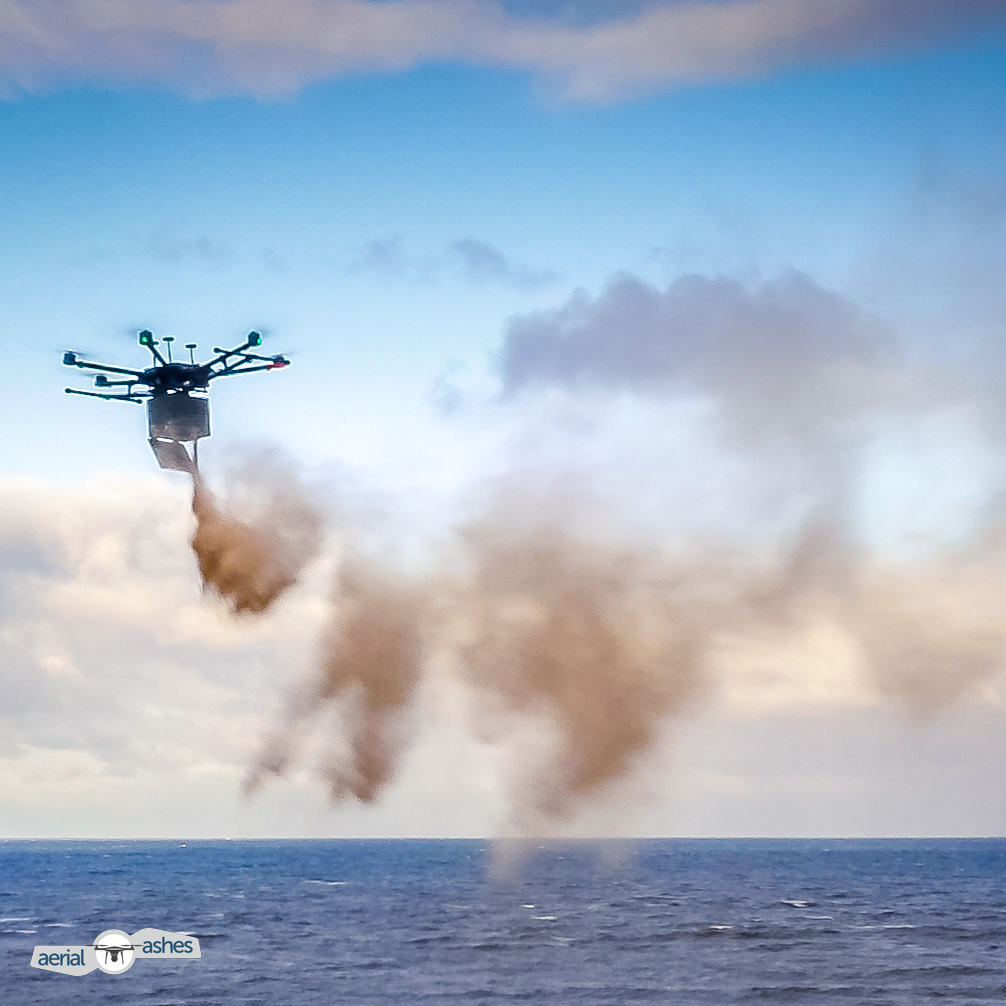
A professional drone ceremony adds controlled aerial release, location planning, weather monitoring and permissions. A CAA-compliant operator should also assess airspace, people, wildlife and safe flight conditions.
Aerial Ashes can help arrange a personalised ceremony through its cremated ashes scattering service, drone ash scattering guide and location guides. You can also explore live streaming and memorial filming so relatives who cannot attend can take part.
The DIY That Went Wrong
Scattering ashes yourself may feel simple, but wind, access, crowds, difficult terrain and permissions can create unexpected pressure. Ashes can blow back towards the family, scatter unevenly or become difficult to release respectfully.
A professional service can manage those practical details while you concentrate on the person being remembered. The ceremony can also be filmed and edited into a permanent video. That recording becomes the keepsake, while the ashes are released rather than kept inside an object.
Learn more about how Aerial Ashes works or use the plan my own ceremony resource to record your preferred location, atmosphere, music and readings.

Is scattering ashes better than keeping ashes?
Neither choice is automatically better. Keeping ashes can offer comfort and closeness. Creating jewellery, glass, artwork or a tree can provide a lasting physical reminder. Scattering ashes can offer release, closure and a connection to a meaningful place.
Choose the option that brings peace, not the option that seems most impressive or expected. You can also combine choices, such as placing a small amount into jewellery and arranging a professional ceremony for the remainder.
Frequently asked questions
What can you make from cremation ashes?
You can make jewellery, glass ornaments, paperweights, memorial stones, diamonds, fireworks, tree pods, decorative urns, artwork and, through some specialist services, tattoo ink. Only a small amount is usually needed for jewellery, tattoos and some art pieces.
How much does it cost to turn ashes into jewellery?
Prices range from approximately £7 for simple self-fill jewellery to £2,000 or more for bespoke pieces. Silver and gold, gemstones, design complexity and the method used to incorporate the ashes all affect the final price.
Can ashes be made into diamonds?
Some specialist companies offer laboratory-grown memorial diamonds using material associated with cremated remains. The process can take several months and often costs several thousand pounds or more. Ask for a written explanation of the laboratory process, timescale and guarantee before proceeding.
Is scattering ashes better than keeping ashes?
There is no universal answer. Scattering may suit people who want a final release at a meaningful location, while keeping ashes may provide comfort and time. Consider the wishes of the person who died, the feelings of close family members and the memorial that feels most peaceful.
References
- GOV.UK. How to get a licence for a burial at sea in England.
- Environment Agency. Scattering ashes: environmental guidance.
- Aerial Ashes. The Complete Guide to Drone Ash Scattering in the UK.
- Aerial Ashes. How We Work.
- Field, N. P., Orsini, L., Gavana, T. and Packman, W. (2009). “Role of continuing bonds in adjustment to bereavement.” Death Studies, 33(8), 709-730.
- Klass, D., Silverman, P. R. and Nickman, S. L. (1996). Continuing Bonds: New Understandings of Grief. Taylor & Francis.
We're Online! How may I help you today?